When people think about healthcare quality, they usually focus on experienced doctors, modern hospitals, and effective treatments. Few consider how much preparation happens before a healthcare professional ever meets a patient. Behind many successful medical procedures are countless hours of practice, teamwork, and learning from mistakes.
For medical students and experienced clinicians alike, knowing what to do is only part of the challenge. They must also know how to respond when a patient’s condition changes unexpectedly. This is where medical simulation has become an important part of healthcare education.
Why Patient Safety Begins With Better Training
Imagine a nurse recognizing that a patient’s breathing has suddenly become irregular. Within seconds, the nurse must assess the situation, contact other team members, and begin the appropriate response. There may be little time to consult a textbook or ask someone to explain the procedure.
Medical professionals develop these skills through education and clinical experience. However, not every situation occurs frequently enough for someone to gain extensive hands-on practice. Rare emergencies can be particularly challenging because healthcare workers may encounter them only a few times during their careers.
Traditional classroom instruction provides essential knowledge, but reading about cardiac arrest is different from coordinating a resuscitation attempt.
The goal of simulation is to narrow that gap. By recreating realistic medical situations, educators can help clinicians practice important decisions in a controlled environment.
According to the Agency for Healthcare Research and Quality, simulation-based education can improve clinical knowledge, practical skills, and teamwork. Some research also demonstrates improvements in patient outcomes, although results vary depending on the type and quality of training.
What Happens During a Medical Simulation?
A typical simulation session begins with a scenario. Participants might be told that a patient has arrived at an emergency department with chest pain, breathing difficulties, or unexplained unconsciousness.
The team must assess the patient, interpret available information, and decide which actions to take.
Unlike a conventional classroom exercise, the situation can evolve as the participants respond. An instructor may introduce new symptoms, change vital signs, or simulate a sudden complication.
Depending on the equipment and educational objectives, training can include:
- Performing cardiopulmonary resuscitation and managing airways.
- Recognizing abnormal heart rhythms and changes in vital signs.
- Practicing procedures with specialized training devices.
- Communicating with other clinicians during emergencies.
- Responding to unexpected complications.
After the exercise, participants review their decisions with an instructor. This discussion, often called a debriefing, helps identify what worked, what caused confusion, and what should change during the next attempt.
Mistakes become opportunities to improve rather than events that could directly harm a real patient.
Why Practicing Emergencies Matters
Some medical situations demand coordinated action within minutes. Cardiac arrest, severe allergic reactions, respiratory failure, and major trauma are examples.
During these events, technical knowledge alone may not be sufficient. Healthcare workers also need to communicate clearly, use equipment correctly, and recognize when a treatment is not producing the expected response.
Simulation allows teams to rehearse these demanding situations before they occur in clinical practice.
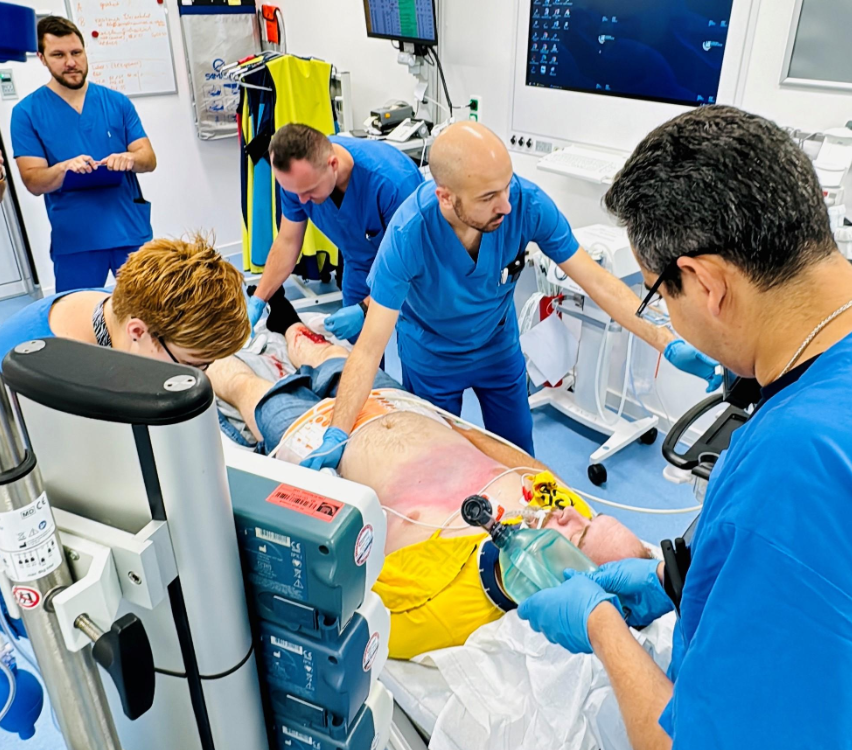
Consider a team responding to a simulated cardiac arrest. One person begins chest compressions, another manages the airway, and a third prepares the necessary equipment. Meanwhile, a team leader monitors the situation and coordinates the response.
Even when everyone understands their individual responsibilities, problems can arise if instructions are unclear or tasks overlap.
Repeating the scenario gives the team an opportunity to improve its coordination. Participants can also practice switching responsibilities or responding when equipment is unavailable.
The Technology Behind Modern Medical Simulators
Medical training has moved far beyond basic plastic mannequins.
Modern educational equipment includes patient simulators with programmable physiological responses, specialized procedural trainers, ultrasound simulation systems, and interactive three-dimensional anatomy platforms.
These tools serve different purposes. A full-body patient simulator may support emergency scenarios, while a procedural trainer allows students to concentrate on a particular clinical skill.
For example, MedVision medical simulators include adult and pediatric patient simulators, ultrasound training systems, and interactive anatomy technology. Such equipment gives medical educators ways to create structured learning experiences without relying exclusively on real patient encounters.
The value of this technology comes from how it is used. Realistic equipment can make an exercise more engaging, but thoughtful scenario design, qualified instruction, and constructive feedback remain essential.
A sophisticated simulator cannot replace a good educator. Instead, it provides another way for educators to teach and assess practical skills.
Better Teamwork Can Be Just as Important as Better Equipment

Healthcare is rarely a solo activity. Even a routine hospital visit may involve nurses, physicians, technicians, pharmacists, and other specialists.
In emergencies, coordination becomes especially important.
A doctor may recognize the need for a specific intervention, but the response can be delayed if instructions are misunderstood or necessary equipment is not ready.
Simulation-based teamwork exercises can reveal these problems in advance. Participants learn to communicate clearly, confirm important instructions, and share relevant information.
The benefits can extend beyond individual skills. A simulated emergency may reveal that supplies are stored in an inconvenient location or that a particular hospital procedure is unnecessarily complicated.
By identifying such issues, healthcare organizations can improve their systems before a real emergency occurs.
What Does This Mean for Patients?
Patients may never see the training equipment used by their healthcare providers. Nevertheless, better preparation can influence what happens during an appointment, procedure, or emergency.
A clinician who has repeatedly practiced a complex task may approach it with greater familiarity. A team that has rehearsed emergency communication may be better prepared to coordinate its response.
Research summarized by the Agency for Healthcare Research and Quality describes how simulation can help identify hidden safety risks, test clinical processes, and support improvements in healthcare delivery.
Still, simulation should not be viewed as a guarantee against medical errors. Patient safety also depends on staffing, professional judgment, organizational culture, equipment, and many other factors.
The strongest approach combines simulation with supervised clinical experience, continuing education, and established safety practices.
The Future of Safer Healthcare Starts With Practice
Medicine will continue to introduce new treatments, tools, and technologies. Healthcare professionals will need practical ways to learn how to use them.
Medical simulation provides one part of that preparation. It allows clinicians to rehearse uncommon emergencies, refine technical skills, and develop better communication habits without exposing actual patients to training risks.
For patients, the principle is simple: the more opportunities healthcare teams have to prepare thoughtfully, recognize weaknesses, and learn from them, the better equipped they may be when real situations demand their attention.
Technology alone does not create safer healthcare. What matters is turning realistic practice into better decisions, stronger teamwork, and continuous improvement.